
Part Two of this article
Laoshi instructed us not to hold our breath during the push. The person being pushed naturally breathes out, absorbing the incoming push. But it is important not to completely breathe out, keeping some Chi in the Dantian. While meditating, emptying the Dantian is not a problem, but while practicing Tuishou, some Chi should remain in the Dantian.
Also, we practiced Nei Li (internal force) facing our partner in Peng (ward off) position There is no movement in this position. Partners remain in Peng position without moving. Then slowly and mindfully move in a horizontal circular pattern while maintaining the Peng (ward off) position. As the partner adds force, absorb it by sinking deeper onto the back leg, relaxing, and Hang Xiong Ba Bei*(slightly bow the back and hollow the chest).
*In this position the goal is not to push your partner but to stay in contact without using Li (hard strength); not being too hard or too soft. Giving enough internal strength to remain in contact with the partner and listening. This is an excellent way to practice Ting Jing (listening energy).
*The challenge is to maintain a root in the midst of an incoming push and to remember when being pushed at the chest; the front knee has to remain relaxed and bent. If the front knee is straight then once a push comes, it is difficult to maintain the root on the back leg. Also remember to keep the head straight, relaxing, hollowing the chest and tucking the Wei-Lu point (tailbone) in the lower back. When a push comes quickly there are times when we need to separate the shoulder from the waist in order to yield. In most situations, however, we want to move the waist and the shoulder as one unit.
Laoshi described the movement of Jing (internal energy). The Jing (internal energy) from the legs and the waist meet at the Ming Men point, which is then expressed through the arms and hands. Jing is generated in the legs and expressed through the arms and hands.Everything moves together.
When practicing Tuishou, the initial push often comes from the attacking partner’s back leg. The partner doing the pushing uses one hand to do the pushing (An).
If you are standing on the right leg as the back leg then push with the left hand, the right hand is empty but not completely empty. The empty hand can be used to prevent the partner from turning after the first push is applied. If the subsequent push comes from the front leg, then the opposite hand becomes the pushing hand.
Hands are soft and agile. Hands are always moving and searching for possibilities to push. Hands are alert to whatever comes. Laoshi frequently reminded us to think of the body as a hand, constantly turning, and changing. As soon as we start to push the hands become alive and ready. The hands are brought up in a ready position. If the hands remain at the side, then there is not enough time to respond to a push to the body.
The hands begin to explore with soft but penetrating pushes to gauge the reaction of the partner. The hands intelligently looking for different parts of the body which may be exposed and open to a push. For example, if the partner turns the waist too much in response to a push, then an opportunity is presented for a push. If a push comes at the chest and the defending partner bends backward onto the back leg then his/her Dantian is exposed. Then it is possible to run the pushing hand down the chest from the first push to his/her Dantian and push again. If in response to a push to the chest, the defending partner turns the body, then the attacking partner can use his/her other hand to push. The hands are constantly in motion, looking and exploring.
Using the hands for Ting Jing (listening), and listen with the entire body. The hands have to be in close contact with the partner’s body. If there is any distance then it is more difficult to really understandyour partner’s intention. Actually, contact enables the practitioner to feel the slightest movement that the partner makes. If there is a feeling of trembling or vibration in the partner’s body, then he/she is using Li (hard strength) rather than Yi (mind intent) to push.
When the partner pushes, know the direction, force and intention of it. If you begin to gather this information when he/she has pushed, it is too late. Ting Jing (listening energy) provides you with this information before the push is actually made. This can be accomplished with soft hands and whole-body integration But, it is necessary to listen with the Yi (mind intent). Listen with the palms. The chi is turning in the center of the palm. Stay soft and listen with the entire body and mind.
We practiced three different ways to respond to a push to the chest; as the arms rise up it is possible for the palms to either face down, to face inward or face upward. The best method is for the palms to face downward so that deflecting and pushing become one movement. Otherwise, it is necessary to use two movements, separately deflecting and then pushing.
Turn the waist to yield and listen for full and empty. Sink and then turn when the push comes; listening and bonding to your partner, constantly looking for opportunities to discharge energy*.
*Discharging of energy can come from rising or sinking on the front leg or the back leg. The push coming from sinking onto the legs can be more stable, although most often practitioners tend to push from the rising position.

Peter Clifford practices Tuishou with Wang Yen-nien. In the back, from left to right, Mark Linett, Henri Mouton, Jean Pai, and Julia Fairchild.
Pushing Sequences (Part 1)
The following notes were taken from a Push hands class on 10/19/93… These notes may be helpful to teachers of Yangjia Michuan Push hands as well as to intermediate and advanced practitioners.
The first 5 Push hands exercises are connected into one flowing movement:
1.Twist the Waistfrom left to right/right to left
2. Right /Left /Twist the Waist (the body’s center moves to the front leg when pushing)
3. Right/Left Bend Backward from the Waist
4. Right/left Bend Forward from the Waist
5. Right/ Left Twist Down on One Leg in a Kneeling Position In this exercise one partner is pushing while the other is yielding.
In this practice, one partner is the pusher while the other is the yielding partner. After a period of practice, they switch roles. One becomes the pushing partner and the other becomes the yielding partner. All five movements are practiced in succession and with pausing.
First, we practiced Basic exercise #1 (Twist the Waist from Left to Right/Right to Left). The pusher begins in a sitting down on his/her back leg. We began by sinking and standing on our left leg, and the right-hand push comes to the partner’s left shoulder. The pusher’s weight remains on the back leg and the front leg turns along with the turning of the waist.
Basic Exercise #2 (Twist the Waist Right/left, center is on the front leg). In this second movement, the push comes from the back leg and he/she moves down onto the front leg to push to the partner’s opposite shoulder*.
*The push here is in a downward direction since the pusher is sinking onto to his/her front leg. From the back leg, the push is can be an upward or downward direction.
Basic exercise #3 (Bend Backward from the Waist) The partner doing the pushing starts on his/her back leg in the downward sitting position and rises to push up toward the center of the chest. The receiving partner bends backward from the waist.
Basic exercise #4, (Bend Forward from the Waist). The fourth push in the sequence comes the pusher starts by standing up and sits down to push out to his/her partner’s Dantian. The receiving partner sits down on his/her back leg.
Basic exercise #5, (Twist Down on one leg in a kneeling position). The final push in
the sequence is a push on the front leg to the side of the body of the partner.
In another class, we practiced Push hands exercises 7,8 and 9 in one flowing movement:
7. Hold off(up) Bending Backward from the Waist
8. Hold off (down) Bending Forward from the Waist
9. Hold Off Stroke from the Side
One partner starts off pushing while the other is the yielding and defending partner. The first movement (Hold off down, bending backward from the waist) is a one hand push (An) to the chest. When yielding to this push the defender/yielding partner raises his/her Peng (Ward Off) and brings up the non-pushing hand in preparation for a push to the chest while sinking back on his/her back leg. (Left hand Peng/right hand push, right hand Peng, left hand push.
The second movement (Hold off upward Bending forward from the waist) in the sequence begins with a downward one hand push (An) to the Dantian (the pusher is standing up and sinks down onto his/her back leg to push). The yielding partner sinks down on his/her back leg receiving the push in Peng (Ward Off). The non-pushing hand comes up making contact with the pusher’s elbow with the palm of his empty hand. If the incoming push is too deep and difficult to yield to, the yielding partner can easily turn the waist and move attacking partner’s elbow to the side.
The third movement in this sequence is a push (An) to the partner’s Peng (Ward Off). The non-pushing hand of the yielding partner comes up in Lu (Rollback)
Next, we practice Two Hands Moving in Vertical Circles (Basic Exercise #12) First, we practice pushing and moving forward onto the front leg and then returning to the back leg. In this movement there is no stepping.
The next part of the sequence is stepping up and then back (front foot stepping up (push) and then moving onto the back foot in Lu (Rollback)) continuing with the Two Hands Vertical Circles exercise.
And finally, we continue practicing Shuang Shou Li Yuan Tuishou (Two Hands Moving in Vertical Circles) by stepping 5 steps forward and 5 steps back while remaining in contact with the partner.
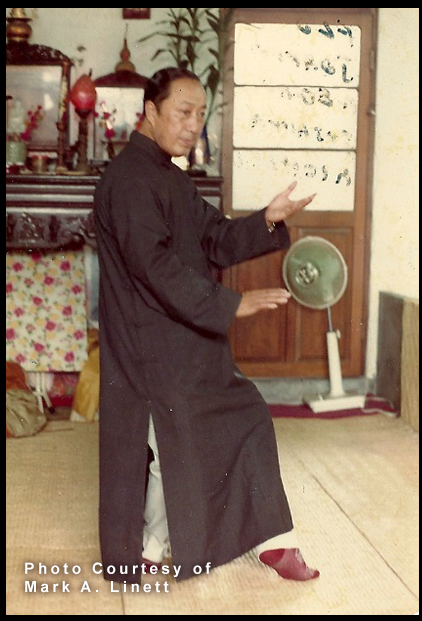
Wang Yen-nien, Twist the Joint/Split (Lieh)
In practicing Ding Jing (the practice of rooting Jing), there is no yielding, only rooting the incoming force. Both practitioners stand facing each other in Peng position. Both partners are motionless and listen to each other, not exerting any force but maintaining light contact. There is no movement in this position. As the partners first come into contact, they listen with their Yi (mind intention) to each other’s Chi. Their arms are relaxed with as little tension as possible. Ideally, if one partner drops his/her arm and releases his/her Peng position, there should be little or no arm movement on the part of the other partner.
Next, both partners in Peng begin to slowly move in a horizontal circular movement, maintaining contact but not exerting Li (hard strength) into their Peng arm. This an excellent exercise for developing and strengthening the root as well developing finer and finer listening skills. (Ting Jing)
Here are two exercises when practicing Peng Fa Jing (expressing energy in Peng),one with no movement(stepping) of the feet and the other stepping up and drawing back. While moving forward with one step, lightly maintaining contact with the elbow of the partner but being careful not to grab the elbow. There is some Nei Li (internal strength) when pushing out. When expressing energy (Fa Jing), tuck the Wei-Lu, relax the chest. Be aware of both back and front.
1. Being in the advantageous position means that you are sitting back on the left leg with the left arm in Ward Off (Peng) position or sitting back on the right leg with the right arm in Peng position.
The receiving partner connects to the elbow of the attacking partner with Lu (Rollback). When in the advantageous position the yielding partner turns his/her Peng at waist level.
2. When the receiving partner has his/her weight on the left leg and the right arm is in Peng or when the weight is on the right leg, and the left arm is in Peng, then you are in the disadvantageous position. The Rollback (Lu) connects to the elbow of the attacking partner and yields at shoulder level.
When a push comes to the Dantian, the yielding partner sinks on the back leg, and connects to the attacking elbow and deflects.
Fa Jing Practice: Peng Fa Jing, Lu Fa Jing, An Fa Jing, Ji Fa Jing, Cai Fa Jing, Lie Fa Jing, Zhou Fa Jing, Kao Fa Jing
Peng Fa Jing, Peng (expressing energy with ward off) energy can be expressed by either standing up or sinking down the weight is resting on the back leg or the front leg. The arm in Peng position pushes out between the elbow and the shoulder of the partner (the upper arm area). In this practice the yielding partner is not directly facing the partner but is standing sideways. The partner receiving the push is cautioned not to turn the body to yield to the Peng Fa Jing and listen to the push and allow it.
* Expressing energy in Peng can be practiced on both the front or back leg, being aware which arm and leg is full and which is empty. For example, pushing on the left rear leg the right arm is in Peng while on the front right leg the leftarm would be expressing the Jing.
An Fa Jing Attacking partner pushes out with one hand at the chest while the defending partner’s hands are crosses over his/her chest for protection from the push. The push comes from the back leg. Ifthedefending partner turns to yield to the push, the attacking partner uses his/her empty/non-pushing hand to prevent the defender from yielding and turning his/her body*.
*When practicing the two hand (An) push in the form, it appears that both hands are pushing but in practice one hand is doing the pushing, (Left back leg/right hand push, right back leg/left hand push) while the other is preventing the partner from turning to yield.
Lu Fa Jing In the first Duan we practice Wield the Pipa. The attacker punches at the chest and the defending partner covers the fist, from on top or underneath the fist and steps back and around with Rollback (Lu) to ward off the attack. The defending partner then expresses Jing to the chest or upper arm of the partner with Lu.
Ji Fa Jing – (Squeeze the two hands with Energy) The attacking partner connects with Peng to the defender’s crossed arms. The attacking partner, borrows the energy of the defender and sinks down on the front leg and expresses Jing with Ji (squeeze)
Cai Fa Jing- the attacking partner throws a slow punch at the defender. Thedefender connects to the elbow and pushes from the back-leg at Dantian level.When a partner attacks with a fist and the defender uses Peng. He/she transforms and intercepts with Cai and thenpushes the partner at Dantian.
Lie Fa Jing– Attacking partner punches and the defender turns over his Peng and connects to the attacker’s wrist, with the other hand, the defender controls the elbow. Then the defending partner then steps up and connects the attacker’s wrist to his partner’s waist and pushes. Control of the attacker’s elbow is very important here. Also be aware that the attacker may attempt to yield to the push to his waist by turning to avoid the push. This would open up an excellent opportunity for the attacker to send the defending partner into the void (Yin Jin Luo Kong).
When practicing Peng Lu An Ji, look for resistances. One person does the pushing and the other does the yielding, then switch. Gradually move into free pushing.
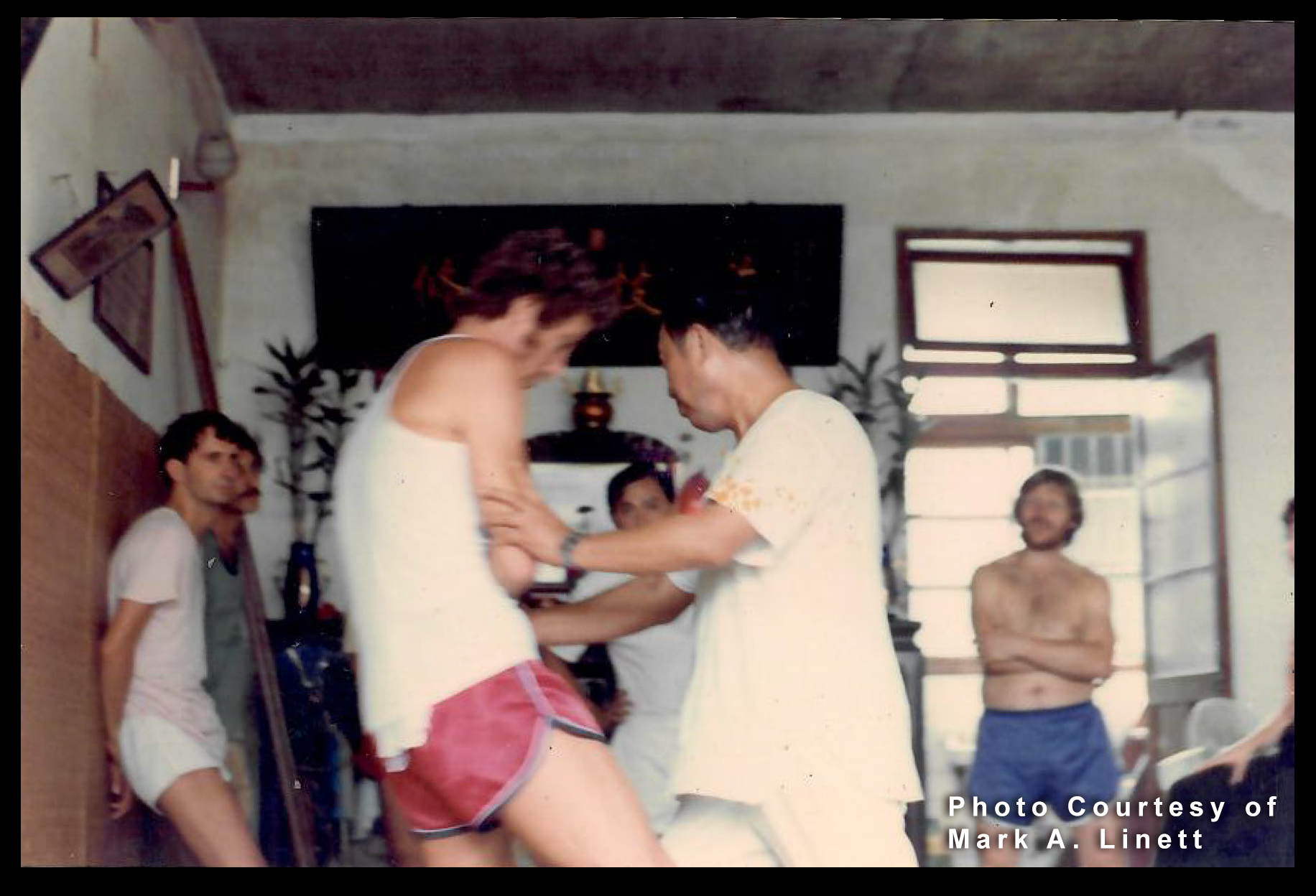
Peter Clifford practices Tuishou with Wang Yen-nien. In the back, from left to right, Mark Linett, Henri Mouton, Jean Pai, John Junge and Julia Fairchild.
In the third of a series of Tuishou workshops, we began our practice with Lu Fa Jing (expressing energy with rollback).
The attacker comes with a punch and the defender uses Peng and then Lu (rollback), on the back leg. Control the elbow with the Lu (rollback) connecting to partner’s arm between the elbow and the shoulder turning of the attacking partner’s wrist and continuing to control the elbow in the same movement.
An to Peng The pusher starts with both hands on the yielding partner’s Peng arm on his/her back leg. With the weight is on the left leg, push with the right hand, the left hand is relaxed and aware. When standing on the right leg, push out with the left hand while the right hand is relaxed and aware.
The partner doing the pushing, sinks down onto the front leg and pushes out with An (One hand push). He/she tucks the Wei Lu (tailbone) point in the lower back and turns the waist.
Ji Fa Jing– (Squeezing the two hands to express energy) The pusher attacks with Ji on the back leg to the defending partner’s Peng. Ji can be practiced with either hand on either foot, but it is important to be clear about which hand/leg is full and which is empty. If we practice with our weight on the left leg, then the right arm is full and the left hand which pushing out at the wrist is empty. If the attacking partner comes onto his/her front leg(right) then the left hand becomes full and the right hand becomes empty. Conversely, when all the weight is on the right leg, then the left arm is full and the right arm is empty. Coming onto the left front leg, the right hand becomes full and the left becomes empty. The change is made in the mind.
One can defend with the spiral and then send it back to the partner breaking his root with it. This is one way to use the spiral. First rooting the energy into the ground as it comes in and then spiraling it back in the form of Jing*.
*Use a straight-line push, finding the line into the partner’s center. If the center of the body is found, then no strength or force is necessary to push. This requires Yi (mind intent). The intention is clear and straight so if the partner turns and deflects, the line of attack to the center continues. The pusher attacks without going beyond the point where he/she loses his/her equilibrium or center.
Root the push by relaxing the Weilu point (tailbone) in the lower back. Stick to the partner like chewing gum, that is very difficult to get rid of.
In Tuishou, use the arms less and the legs more and do not allow the knees to collapse in. The weight is on the back leg and be able to lift the front leg without moving the body. Practice rooting by standing on one leg. Relax the arms by the side of the body and tuck the Weilu point (tailbone). Breathe deep into the Dantian. Relax and listen to your partner’s energy. If the partner is not relaxed you will know when he is going to push. Being on the back leg while practicing Push hands enables the practitioner to use the waist. Being on the front foot may give the partner the opportunity to trip you.
If your partner doesn’t push, then don’t move
Develop and practice the Yi (mind intent)
Laoshi pushed at the Dantian of each student and then pushed at the back to see if we were stable.
Laoshi talked about the breath. Breathing through the nose and out the nose cools the body. This breath is preferably used during the summer. Breathing in through the nose and out the mouth can be trained all year, but better in the autumn. Breathing in through the mouth and out the mouth is a breath used to warm the body. A breath for the winter.
Here we are practicing moving and refining chi.
Moving chi around the back for men and around the front for women. For men the front of the body is Yin and the back is Yang. While for women the front of the body is Yang and the back is Yin.
Breath has to be long and quiet; long enough to move chi a long way. During the in breath the tongue touches the roof of the mouth and on the out breathe the tongue comes between the teeth and splits the breath so there is no loss of Chi. Breathing is a purifying and refining process. The chi from the air moves down to the Dantian and impurities leave the body through the lungs. The Yi shows the way for the Chi like a guide which shows the way. With practice the chi moves on its own.
Movement of the Chi to Dantian; particularly to the Chi Hai (Sea of Chi) in the Kidney area in the back. Breathing into the Dantian filling the Sea of Chi. It takes all the Chi you can give it. Then empty half the chi on the out breath. When sitting in meditation all the Chi can be expelled but when doing Tuishou the Sea of Chi should retain some chi.
The body becomes like a hard rubber ball that can bounce your partner away; no matter where the push comes.
Whether to the Dantian or the shoulder, absorb the push into the root and the opponent will be pushed away. The whole body becomes filled with Chi and the internal and external becomes one chi.
When sitting in meditation or doing T’ai Chi, the Weilu (tailbone) point is tucked so that the Bai Hui and the Huiyin points are in alignment. This allows the Chi Hai (Sea of Chi) to relax and fill up with Chi.
Be more and more relaxed and be in the center, which is stillness.
When being pushed at the Dantian be rooted and do not resist. If there is any resistance, then when the person doing the pushing pulls his or her hand away, the person being pushed will move. Try not to resist any push. Most people respond to their partner; if he/she is relaxed, they will relax, if he/she is using hard strength, they will use hard strength. Do not respond to the environment but remain in the center, which is stillness.
Do not use brittle Li (hard strength). Brittle hard strength against soft strength will break like a bat hitting a rubber tire. The bat will get bounced away. Ding Jing is not always yielding Jing. It is a non-yielding kind of Jing, which is another weapon we have. It is not to be used all the time. When using Ding Jing, fill up the Dantian and the Chi Hai with Chi. The Chi also protects these areas from attack.
When doing the form, the body moves together. The arms or any part of the body do not move alone but as one unit.
End of Mark’s Notes, Installment 1
 New York City Yang Family Hidden Tradition