


Wang Yen-nien, Ward Off (Peng).
This is the first installment of the notes that Mark Linett, one of the original Western students of Master Wang Yen-nien, has put together, with commentary. We are honored that he is allowing the NYC Yangjia Michuan Taiji site to publish them in their entirety. There will be installments published throughout the summer of 2025. Below is a short note about Mark, followed by the table of contents and the first installment, which takes us into Chapter Two – Pushing Sequences. Mark is open to questions and feedback – you are welcome to leave a comment or your questions at the bottom of the page, which allows other readers to benefit from questions and answers.
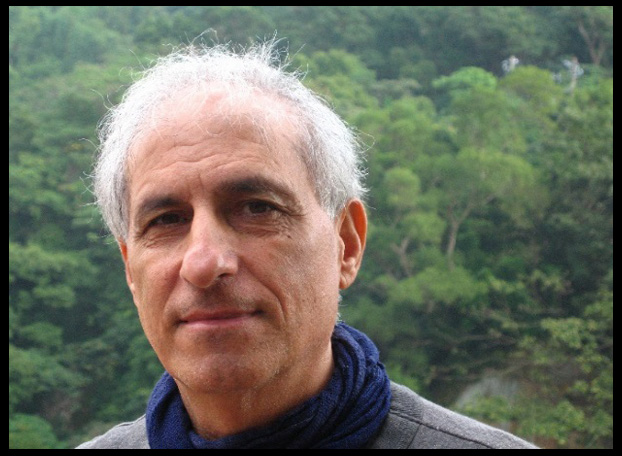
Mark lives in Taipei with his wife Wendy. He began practicing Yang and Wu style T’ai Chi in New York in 1978, but was soon off to Asia to look for a teacher.
After spending some time in India he set off for Taiwan where in late 1982 he began studying with Master Wang. He has taught Yangjia Michuan here in Taipei, as well in Germany and in the U.S and he presently continues researching, practicing and teaching Yang Jia Michuan Tai Chi Chuan.
Taipei Notes and Commentaries on Tuishou – Installment 1
Contents
Dedication……………………………………………2
Journal Notes……………………………………… 3-10
Pushing Sequences………………………………10-37
Practice Methods……………………………… 37-48
Push Hands Basic Exercises………………… 49-50
Seven Important Tuishou Concepts………51-52
Commentary on the Basic Exercises……. 53-72
Looking for Opportunities…………………….72-79
The Hands in Tuishou………………………….. 79-83
Yi, Li and Ting Jing……………………………… 83-89
Glossary………………………………………………..90-93
Dedication
These notes and commentaries are dedicated to Wang Laoshi’s teaching as well as to the teachers and practitioners who carry on and develop the practice of Yang Jia Michuan T’ai Ji Quan.
There must be a word of deep gratitude to Wang Laoshi for his teaching. The notes certainly speak for themselves as to the depth and breadth of his teaching.
Many thanks to Julia Fairchild for her translation during the workshops and to my wife Wendy for her help in editing and translating the text into Chinese. Also, thanks to Noelle Kasai for her encouragement and advice.
Mark A. Linett Taipei 2023

Wang Yen-nien and students at the first Yang Jia Michuan Festival in Strasbourg, 1986.
Journal Notes
Over the years that I have practiced Yang Jia Michuan Tái Chi, I have been keeping journals with notes of lessons and comments that Laoshi made during our classes. Many of the notes were taken after I had returned home and scoured my memory for the treasure trove of wisdom and information that Laoshi gave us during our Tuishou and form classes. I have laid out the information in much the same way that I first jotted it down in my journals. Hopefully my fellow practitioners with a strong interest in Tuishou will find some use for the information in their practice or at the very least use it as food for thought.
I will be referring to Push Hands as Tuishou. Anyone familiar with Wang Laoshi’s teaching will know that he often repeated information that was important and worth our attention.
There may be some repetition in the notes. Perhaps bear in mind that if it is repeated it is well-worth recalling and putting into practice.
In the first section, the italicized print indicates my comments. In the second section, I will be adding my commentaries on the basic exercises and Wang Laoshi’s reflections will be in italics.
In Tuishou, as soon as the hands meet a partner, start to change. Do not stand and wait to be pushed. Use one hand then the other to push and channel energy. Hands are lively, rotating, sticking, and changing. Hands are be light and listening and work together. They are constantly listening and transforming. Allow the hands to rise and to make contact with the partner. Also, use the body to listen to your partner’s hands while looking for the partner’s center. Changes and transformation become manifest through familiarity and the movements become so familiar that the hands move without thinking. Practicing sticking to your partner and it feels like there are suction cups on your hands.
Move out of the realm of hard external strength (Li) and resistance and be in the realm of internal strength (Nei Li) and relaxation. This is the path, which leads to real Gongfu (skill achieved through hard work and practice). If you use strength and resistance, you will become strong to a point, but if you stop practicing you will regress quickly.
Being relaxed and soft enhances yielding and the ability to deflect an incoming push. In deflecting, meet the incoming force with soft listening energy; Song (relaxation) and Ro (softness), not losing contact, absorbing and sticking.
The whole body moves together from ankle to the wrist.
Empty, and entice your partner to fall into the void, temporarily losing balance and root. Be ready for that moment.
Being out of breath indicates the use of Li (external strength) rather than Nei Li (internal strength). There is a limit to hard strength but there is no limit to internal strength.
The partner feels controlled even without being pushed. Start to build a web from where your partner cannot escape. You are controlling him/her. As soon as there is a break, energy can be expressed (Fa Jing). Keep the heart and mind on the straight.
Sticking is soft, with no resistance or use of hard strength. Use the mind and chi and when pushing, look for the straight line into your partner’s center*.
*Connecting to a person’s center requires a degree of listening skill, as well as a fair bit of experience and practice. With the first push one rarely finds the center of the partner. It requires several pushes. Laoshi often spoke of a soft agile hand on the body of partner; with a soft hand one can gently find the center of the partner. This is the moment of opportunity to push. The idea is to continuously search for the partner’s center, looking for opportunities and not to push before finding one.
Using Li (hard strength) is going off on a tangent. Outside is soft, calm and relaxed. Remove Li (hard strength) from your vocabulary. Nel Li (Internal strength) comes from the Dantian and the whole-body channels energy. The arms and waist move as one. With the waist moving and turning, naturally, circularity will appear. The chi and the body become like a ball with the Dantian as the center. All movements are circular with the upper and lower body working together.
Keep the chi in the Dantian and move the chi to the point where you come in contact with the partner. The chi is flowing in a circle. Moving slowly is OK, but do not stop or break the flow of chi. He compared the flow of chi to a tornado. It moves in a circle with no stopping. Even breaking your partner’s root is done with a circular movement. Use Yi (mind intent) to lead the Chi. Chi leads the body.
In April of 1993 Laoshi taught a class in which we practiced rooting. During this class students were first asked to push at the Dantian of our partner and then at the Ming Men*
* (A gate where energy Yuan Qi, (Prenatal Chi) is stored. It is located between the kidneys in the lower back in a direct line from the Zhong Dantian, (Middle Dantian).
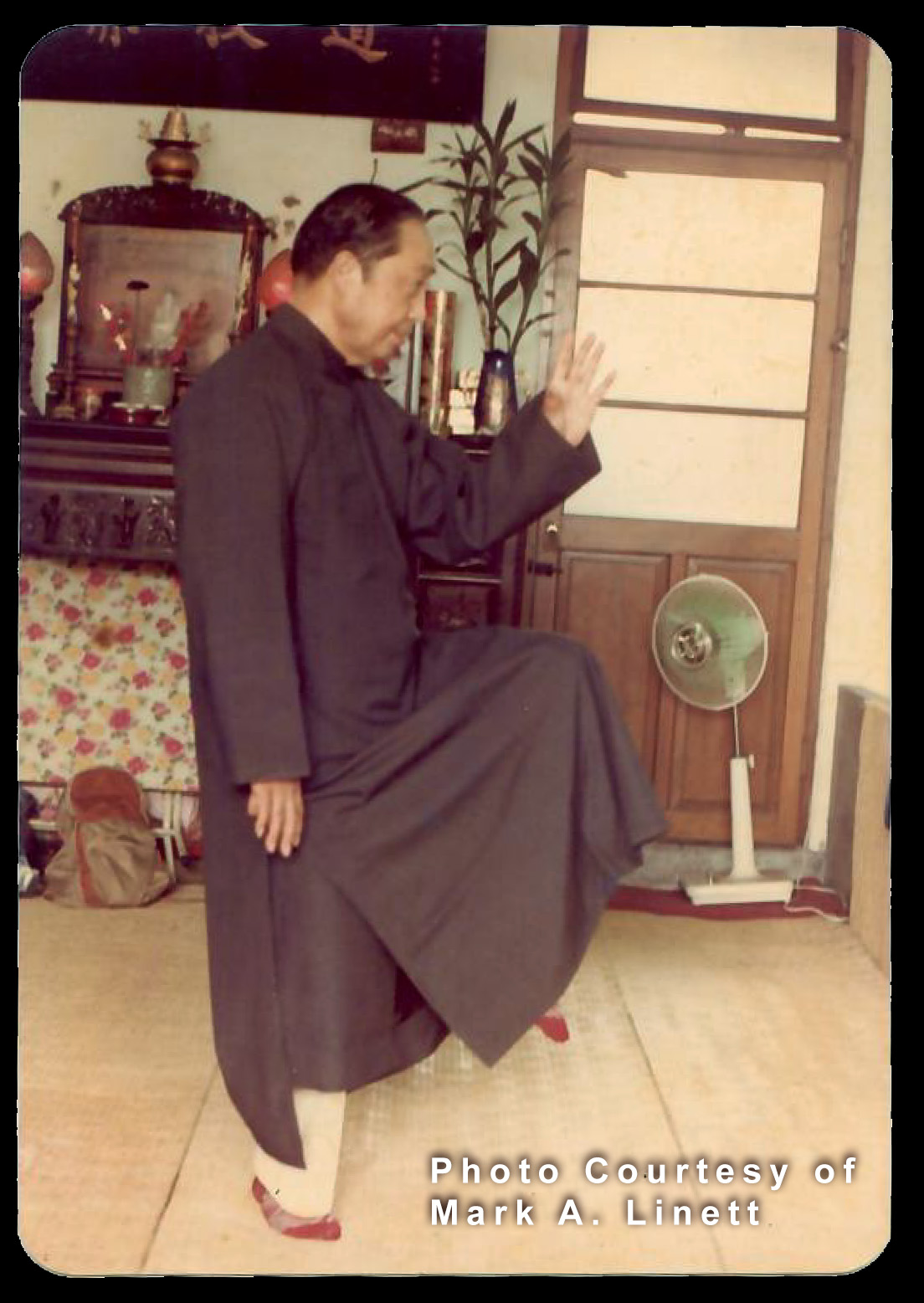
Wang Yen-nien, The Golden Rooster Stands On One Leg.
Click on the number two to read the second part of this article
 New York City Yang Family Hidden Tradition